
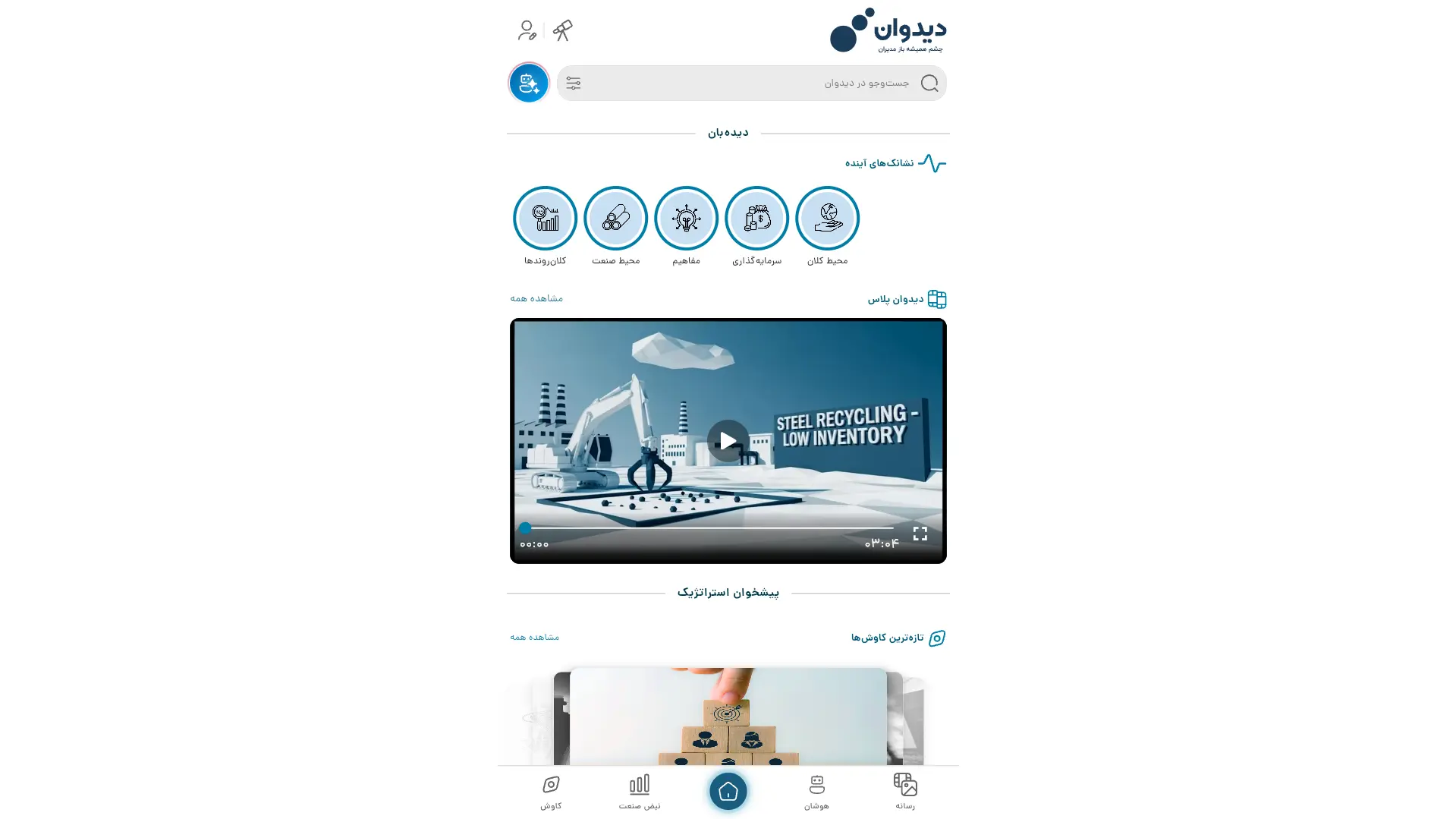

Didvan – Strategic Intelligence Platform
Didvan is a multi-platform strategic intelligence application I helped build, designed to unify a complex ecosystem of data, analytics, and specialized content into a single cohesive experience. The product spans Android, iOS, and the Web, all coordinated through an integrated Node.js server, a Flutter-based mobile codebase, and several React/Next.js web platforms. The challenge was to create a structure capable of supporting real-time insights, analytical storytelling, multimedia content, and multiple external platforms, while still feeling seamless to users navigating between environments.
To achieve this, the application is organized into distinct modules, each with its own functional requirements and interaction patterns. “Donyay Foolad” handles high-frequency content ingestion, search, filtering, bookmarking, and threaded communication with editors. “Pooyesh Ofogh” was engineered for richer analytical output, combining text, charts, images, and narrated audio within a structured category system. The “Studio Didvan” module supports podcast and videocast workflows with full sorting and discovery tools, while “Rasadkhaneh Man” focuses on data persistence, custom user notes, and personal knowledge management.
A key architectural component of the project is its hybrid design. Several external systems—Trend Radar, Technology Radar, Risk Radar, Startup Radar, and Saha—exist as standalone Next.js applications and are integrated into the mobile app through WebView. This approach allows each subsystem to evolve independently while preserving consistency in the user experience. Managing cross-platform interactions, navigation flows, and communication between native Flutter layers and embedded web content became an essential part of the development process.
The project also includes support messaging, content-linked conversations, and a flexible customization layer where users can adjust typography, themes, and notification settings. Building Didvan required attention to both structural scalability and day-to-day usability, from data modeling and UI architecture to state management, caching logic, and long-term maintainability. The result is a cohesive, multi-module environment that demonstrates how complex, insight-heavy platforms can be built in a clean and modular way.